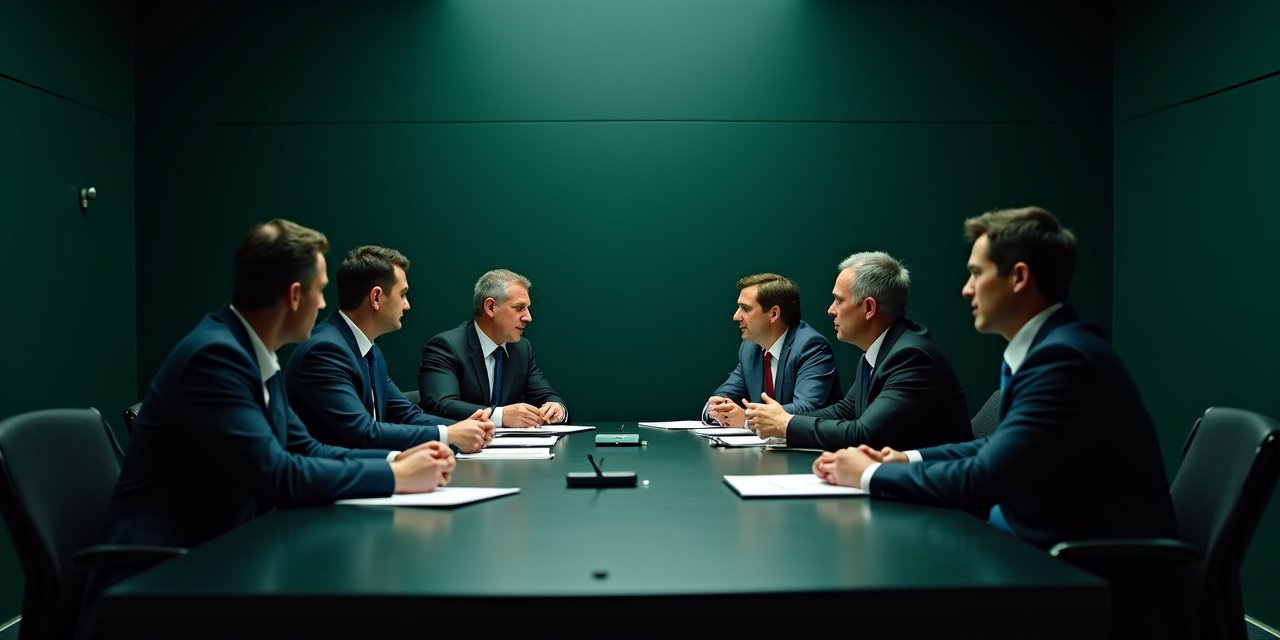
Every CEO eventually becomes their organization's constraint. The question is whether they recognize it before it limits the company, or after. The executive team problem that most C-suite coaching engagements eventually surface is this: the team is capable on paper and individually competent, but the system built around the CEO's decision-making, approval authority, and communication style prevents the team from performing at its actual capacity.
This is not about weak executives. It happens most often to strong ones. The CEO who built the organization through force of personal capability creates structures and cultures that require their continued involvement at levels that do not scale. The solution is not to work harder or hire differently. It is to redesign the architecture that makes the CEO a prerequisite for team performance.
When the CEO Becomes the Ceiling
The CEO performance ceiling is a specific and diagnosable phenomenon. It appears when the team's output is limited not by the team's aggregate capability but by the CEO's bandwidth, decision speed, risk tolerance, or communication availability. The ceiling can be behavioral, structural, or both.
A 2024 Gallup study found that 55% of C-suite executives reported that their organizations had outgrown their CEO's direct management capacity, while only 23% of those CEOs recognized this as the primary constraint on organizational performance. The gap between executive perception and organizational reality on this dimension is large and consistent across industries.
The behavioral ceiling occurs when the CEO's involvement in operational decisions, communication preferences, or approval requirements slow team execution below the team's natural pace. The team is capable of moving faster, but the system waits for the CEO. This is most visible in organizations where the CEO attends too many meetings, where significant decisions require CEO sign-off even when the CEO adds limited value to that decision, or where direct reports spend meaningful time managing the CEO rather than managing their functions.
The structural ceiling occurs when the organization's systems, processes, and information flows are designed around the CEO as the central node. Information routes to the CEO before moving laterally. Decisions require CEO framing before teams engage. This structural centralization was often rational when the company was smaller and faster. It becomes a constraint as the organization scales.
McKinsey research on organizational bottlenecks found that CEO-centered decision structures reduced executive team decision velocity by an average of 37% compared to teams with distributed decision authority at the senior level. The velocity loss is not hypothetical. It is measurable in cycle times, approval queues, and project completion rates.
Diagnosing the Constraint
Before redesigning the system, the CEO needs an accurate diagnosis of where they are actually the constraint. Not all CEO involvement is problematic. Some decisions genuinely require the CEO. The diagnostic question is: which of my current involvements reflect genuine irreplaceable value, and which reflect habit, anxiety, or structural default?
Three diagnostic tools produce useful data. The first is a decision audit: for 30 days, track every decision that required CEO input or approval. Classify each by whether it required CEO authority (irreplaceable), CEO judgment (potentially replaceable with trust and clarity), or CEO involvement by default (habit or organizational expectation). Most CEOs discover that 50-60% of their decision involvement falls in the third category.
The second tool is a team self-coordination test: identify five decisions or actions in the past quarter that required cross-functional coordination at the senior level. How many of those were coordinated by the team without CEO involvement? How many required the CEO to facilitate, broker, or arbitrate? Teams that cannot coordinate laterally without the CEO present are not a team. They are a collection of functional heads who share a CEO.
The third tool is a calendar analysis: what percentage of the CEO's meeting time involves decisions or discussions that could be handled by a direct report with appropriate authority? Harvard Business Review research found that CEOs spend an average of 28% of their time in meetings that could be run by a direct report without loss of decision quality. This is bandwidth that could be redirected to the CEO's genuinely irreplaceable functions.
Delegation depth is the specific capability being tested here. Most senior leaders delegate tasks. Fewer delegate the authority to make the decisions that surround those tasks. The gap between task delegation and authority delegation is where the CEO constraint lives.
Building Self-Coordination Capacity
Self-coordination at the executive team level means the team can make and execute cross-functional decisions without routing through the CEO. Building this capacity requires three things: shared context, clear decision rights, and the social infrastructure to disagree productively.
Shared context means executive team members understand not just their own function but the strategic logic, resource constraints, and organizational priorities well enough to make decisions that account for their cross-functional implications. Most executive teams do not have this. They have functional expertise and strategic summaries. The gap between those two is where coordination failures occur. A 2023 Deloitte study found that only 34% of executive team members could accurately describe the top three priorities of their two closest peer functions.
Shared context is built through deliberate information sharing practices, not through more meetings. Regular structured peer briefings, shared dashboards with cross-functional visibility, and joint planning sessions that require each executive to engage with peers' constraints rather than just their own build the contextual foundation that enables lateral coordination.
Clear decision rights mean each team member knows which decisions they own, which they make jointly with peers, and which require escalation. The RACI framework, despite its limitations, forces the clarity that most teams avoid. Research from MIT Sloan Management Review found that teams with explicit decision rights frameworks resolved cross-functional conflicts 58% faster than those relying on case-by-case escalation.
Psychological safety is the social infrastructure. Executive team members who risk their position by taking coordinated action without the CEO's explicit blessing will not self-coordinate regardless of what the decision rights document says. The CEO who wants a self-coordinating team must explicitly and repeatedly demonstrate that coordinated action taken in good faith will be supported, not penalized, even when it turns out to be wrong.
Creating Productive CEO Challenge
The team that never challenges the CEO is not a high-performance executive team. It is a sophisticated execution machine for the CEO's ideas, which limits team performance to the quality of the CEO's thinking. High-performance teams challenge the CEO's direction, assumptions, and decisions, and the CEO builds the conditions that make this possible rather than suppressing it.
Research published in the Academy of Management Journal found that CEOs who received substantive challenge from their executive teams made measurably better strategic decisions, with a 40% reduction in major strategic errors compared to teams where CEO positions were rarely questioned. The mechanism is not conflict for its own sake. Challenge surfaces information and perspectives the CEO's own thinking misses.
Building productive challenge requires the CEO to distinguish between compliance and commitment. Compliance means the team executes the CEO's direction whether they agree or not. Commitment means the team genuinely agrees or has been heard and accepts the decision after disagreement. Teams operating on compliance cannot challenge effectively because the cost of challenge, in relationship capital and political risk, exceeds the benefit in most individual cases. Teams operating on commitment challenge because they have standing to do so.
The practical mechanism is what some organizations call "disagree and commit" protocols, borrowed from Amazon's decision culture. The team member states their disagreement explicitly, explains their reasoning, and then commits to full execution of the decision even if it goes against their position. This separates the voicing of disagreement from defiance, making challenge safe while preserving execution coherence.
The CEO's role is to actively create challenge opportunities. "What am I missing?" asked genuinely and received non-defensively is more valuable than any formal challenge process. Authoritative leadership includes the authority to invite and receive challenge without losing standing. CEOs who cannot do this have an authority and credibility problem that no team structure will fix.
Delegation Architecture That Holds
Delegation without architecture collapses. The CEO who delegates authority without building the supporting structures finds that decisions return to them through the back door: team members seek informal approval, the CEO gets pulled into implementation details, or errors occur that the CEO treats as evidence that delegation was premature.
Delegation architecture has four components. First, explicit authority boundaries: the team member knows exactly what they can decide without consultation, what they should communicate before deciding, and what requires joint decision. These boundaries are written, not implied. Second, information agreements: the CEO and direct report agree on what information the CEO needs to receive and when, independent of whether a decision is required. This prevents the CEO's information anxiety from pulling them back into operational involvement.
Third, error agreements: what categories of error are the direct report expected to handle autonomously, and what categories require CEO involvement? Without this, every error becomes a potential breach of delegation because the CEO's involvement threshold is undefined. Fourth, review cadence: when will the delegation boundaries be reviewed and adjusted based on demonstrated performance? Delegation that has no review mechanism either atrophies or expands uncontrollably.
Research from the Center for Creative Leadership found that executives with structured delegation agreements reported 44% higher team performance ratings after 12 months compared to those using informal delegation. The structure is not bureaucracy. It is the architecture that prevents delegation from reverting to centralization under pressure.
Hiring for Autonomy, Not Compliance
The executive team constraint problem is frequently a hiring problem. CEOs who have learned to be the constraint hire in their own image: executives who are excellent at executing the CEO's direction but less equipped for autonomous strategic judgment. The result is a team that performs well when the CEO is present and engaged, and poorly when they are not.
Hiring for autonomy means specifically assessing candidates' capacity to make sound independent judgments in ambiguous situations, their tolerance for action without complete information, and their willingness to hold a position under pressure from authority. These are not the capabilities most CEO hiring processes evaluate. Standard executive hiring focuses on functional expertise, track record, and cultural fit, all of which are relevant but none of which directly assess autonomous performance capacity.
A 2023 Spencer Stuart survey found that 67% of CEOs reported that at least one current direct report was stronger as an implementer than as an independent strategic actor, and that this was a deliberate or inadvertent result of their own hiring preferences. The CEO who prefers agreement over challenge consistently hires agreement-oriented executives and then wonders why the team does not perform autonomously.
The interview question that surfaces autonomous judgment: "Describe a situation where you disagreed with your CEO's direction, believed the direction was wrong, and tell me what you did." Candidates who handled this well will describe a specific instance, their reasoning, how they communicated the disagreement, and what happened. Candidates who have not done this, or who describe compliance as the appropriate response, are telling you about their ceiling.
Team-Level Accountability Without the CEO
High-performance executive teams hold each other accountable, not just up to the CEO. This lateral accountability is the hardest cultural element to build because it requires peer relationships with enough trust and directness to surface poor performance, missed commitments, and strategic errors at the peer level rather than waiting for the CEO to notice.
Patrick Lencioni's research on dysfunctional teams identifies "avoidance of accountability" as one of the five core failure modes, and his data shows it is most prevalent at the senior level, where executives have the political sophistication to avoid conflict and the organizational standing to make accountability conversations costly for anyone who initiates them.
Peer accountability requires two conditions. First, a shared operating agreement that defines what team members owe each other: meeting commitments, response timelines, decision quality standards, and communication norms. When these are written and agreed upon, accountability becomes enforcement of a shared agreement rather than a personal attack. Second, regular structured peer feedback, not only upward feedback to the CEO. Teams that give each other substantive feedback quarterly develop the relationship infrastructure to address performance issues as they emerge rather than allowing them to compound.
The peer accountability structures article covers the specific mechanisms in more depth. The CEO's role in building team accountability is to model it: when the CEO misses a commitment, they acknowledge it explicitly, without minimization, and correct it. The team's accountability norms follow the CEO's behavior, not the CEO's stated expectations.
The CEO Role Shift Required
Building a team that performs when the CEO is the constraint requires the CEO to change their role, not just their behaviors. The behaviors will revert to old patterns unless the underlying role conception changes. The CEO who understands their job as "best decision-maker in the room" will recentralize authority under pressure. The CEO who understands their job as "architect of a system that makes good decisions" will build differently.
Research from the Korn Ferry Institute found that CEOs who explicitly reframed their role from operator to architect showed a 31% improvement in executive team performance scores over 18 months, while those who attempted behavioral changes without the role reframe showed improvements that faded within six months as pressure pushed them back toward familiar patterns.
The role shift has specific implications. The CEO's primary value-add moves from making decisions to setting decision criteria that others can apply. From providing solutions to surfacing the questions that help the team find better solutions. From being present in coordination to designing coordination structures that work without their presence. From being the cultural standard-bearer through personal example to building the cultural infrastructure that sustains standards when they are not watching.
This shift requires the CEO to tolerate decisions being made differently than they would make them, and to maintain that tolerance even when the different decision produces a worse outcome. The CEO who overrides team decisions when outcomes are poor teaches the team that their autonomy is conditional. Conditional autonomy is not autonomy. The team learns to wait for the CEO rather than risk the authority reversal.
The evidence-based leadership development research is consistent: executive team performance is strongly predicted by CEO behavior, specifically the CEO's capacity to build systems that do not require them. The limiting factor in most high-capability teams is not the team. The limiting factor is a CEO who has not yet made the transition from being the organization's best performer to building an organization that performs without requiring them to be best.
CEO Constraint Self-Diagnostic
Rate each statement from 1 (rarely true) to 5 (almost always true). Be honest, this is for your use only.
1. Cross-functional decisions stall when I'm unavailable for more than 48 hours.
2. My direct reports rarely push back on my strategic positions in team meetings.
3. Most significant decisions in my organization flow through me at some point.
4. My team members hold each other accountable without needing me to intervene.
5. I know which decisions I am adding unique value to vs. attending out of habit.
The most capable executive teams are built by CEOs who chose to be the architect rather than the answer. Coaching accelerates that transition by surfacing exactly where the current structure requires you and designing around it.
Start a Conversation →The organizations that scale most effectively are not the ones with the best CEO. They are the ones with the best CEO-to-team architecture. The CEO's individual performance ceiling becomes irrelevant when the team is designed to operate above it. Building that design is among the highest-impact things a C-suite leader can do, and it is among the things most consistently avoided because it requires the CEO to confront the ways their own patterns have become the organization's constraint.
Ready to build your leadership performance system?
Aevum Transform connects C-suite leaders with executive coaching infrastructure.
Affiliate disclosure: This page contains affiliate links. See our disclosure policy.
Review Coaching Options →